To choose an applicant tracking system that integrates with Indeed effectively, you need to look beyond the basic "yes, we integrate" claim.
To choose an applicant tracking system that integrates with Indeed effectively, you need to look beyond the basic "yes, we integrate" claim. Focus on three things:
- whether you can control how candidates apply on a job-by-job basis
- whether you can track which candidates came from Indeed
- whether the ATS has features that enable you to process and respond to high volumes of applications quickly
That's the short answer, but choosing the right ATS for Indeed integration deserves more thought. Indeed is, quite simply, the Google of job boards. It was designed to be "one search, all jobs," and it's become the single biggest source of candidates for most UK employers.

Indeed’s home page in 2004 (source: https://web.archive.org/)
At hireful, we see 54% of our customers' applications coming through Indeed Easy Apply, with another 9% coming via Indeed redirect (as of December 2025). That's nearly two-thirds of all applicants arriving through one channel.
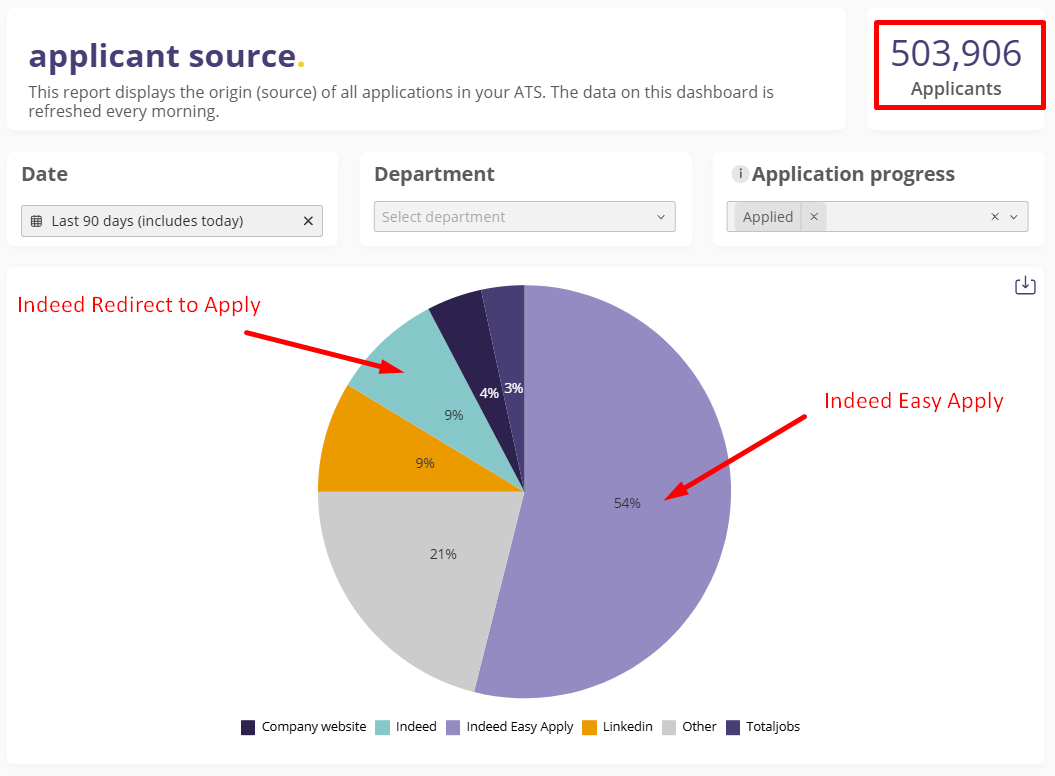
Hireful ATS data from Dec 2025.
In this post, I'll walk you through what to look for when choosing an ATS that works properly with Indeed, the questions you should be asking vendors, and how to make sure you're not losing good candidates to competitors who simply respond faster than you do.
Contents
- What does ATS-Indeed integration actually mean?
- Why Indeed integration matters for your recruitment
- How to evaluate an ATS for Indeed integration
- Frequently asked questions about ATS Indeed integration
- Conclusion
What does ATS-Indeed integration actually mean?
An ATS-Indeed integration means your applicant tracking system connects directly with Indeed's platform to automatically post your jobs and receive applications without manual data entry. However, not all integrations work the same way, and the differences matter significantly for your recruitment outcomes.
Indeed currently integrates with 302 ATS providers globally (as of December 2025). When Indeed partners with an ATS provider, they put quite strong requirements on how the integration works.
The key thing to understand is that it's typically "all or nothing": if you turn on the Indeed integration in your ATS, all of your jobs will go to Indeed. You can't pick and choose at that level. However, the better ATS platforms (hireful included) let you control how candidates apply on a job-by-job basis, which is where the real flexibility lies.
- Redirect to Website: Best for roles requiring detailed screening, such as graduate schemes, not-for-profit, or regulated roles (e.g., those needing DBS checks). The longer application form helps filter candidates by gathering comprehensive information like competency answers or employment history.
- Indeed Easy Apply: Best for hard-to-fill or niche roles where maximising applicant volume and speed is the priority, as the low friction process encourages quick mobile applications.
Your ATS-Indeed integration handles several things: pushing your job adverts to Indeed, receiving applications back into your ATS, and increasingly, passing data back to Indeed about how quickly you respond to candidates.
This last piece is becoming more important because Indeed now shows "responsive employer" badges to job seekers, letting them know which employers actually get back to people. If your ATS passes this disposition data back to Indeed, you can earn that badge and stand out from competitors who leave candidates waiting.
Pro tip: When evaluating an ATS, ask specifically whether they pass disposition data back to Indeed. This determines whether you can earn the "responsive employer" badge that makes your jobs more attractive to candidates.
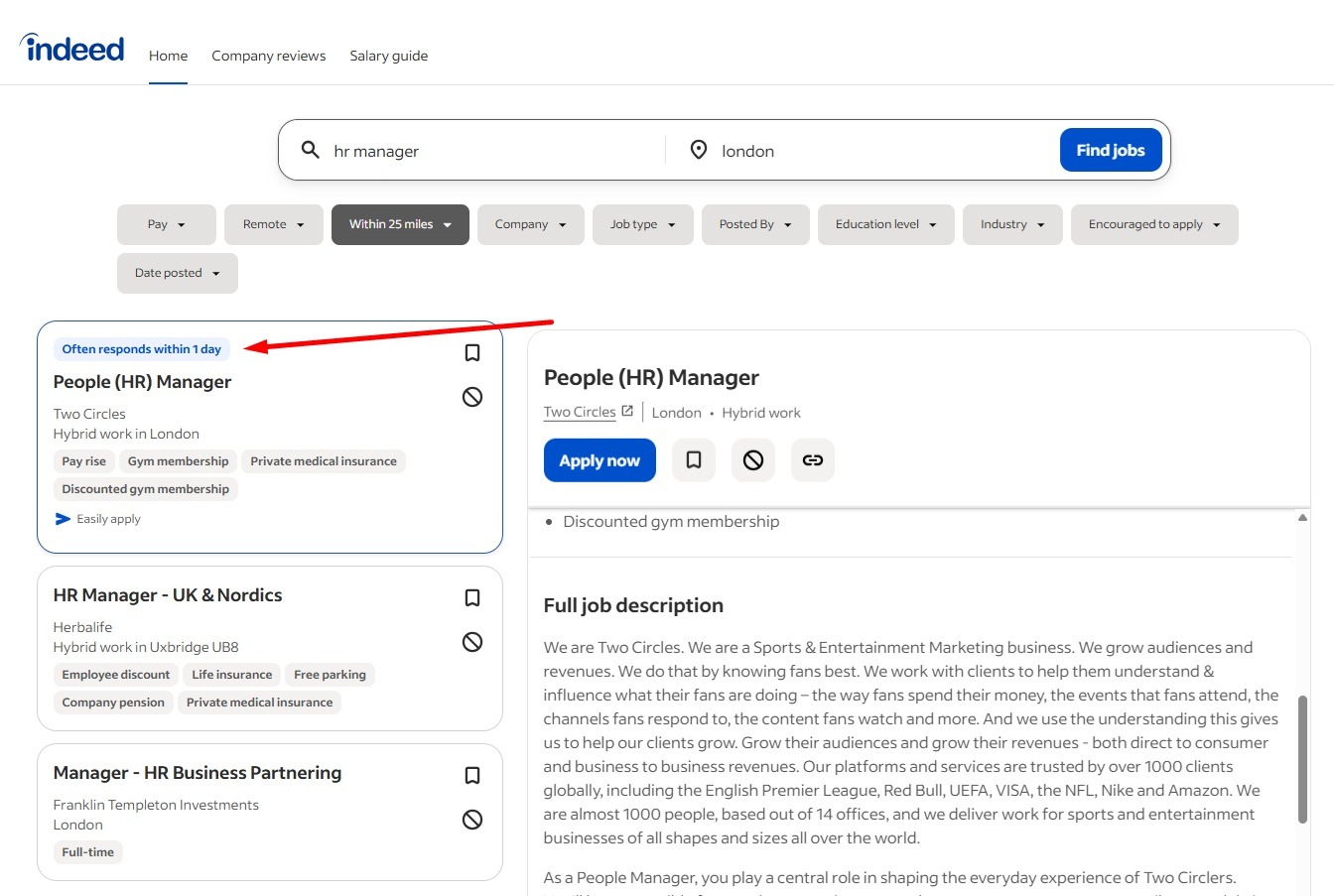
When your ATS can tell Indeed if you are responding, Indeed is able to highlight your responsiveness to jobseekers.
Why Indeed integration matters for your recruitment
Indeed integration matters because Indeed dominates the UK job market, and how you handle Indeed applicants directly impacts whether you hire good people or watch them accept offers elsewhere. The platform was founded in 2004 with a simple mission: be the Google of jobs. That mission succeeded, and surveys consistently show that job boards are the most popular channel for UK job seekers, with Indeed being the most popular job board.
Volume and visibility
The sheer volume of candidates on Indeed makes integration essential. When I look at hireful's customer data from December 2025, I see that Indeed Easy Apply roles receive [XX] applicants per vacancy on average, compared to [XX] for redirect-to-website roles.
That's a significant difference, and it comes down to friction. Candidates on Indeed are often browsing on mobile, time-poor, and comparing multiple opportunities. If your application process requires them to leave Indeed, create an account, and fill in a lengthy form, many will simply move on to the next listing where they can apply in two clicks.
When you need to redirect applicants, it's crucial to streamline the process to minimise drop-off. hireful's ATS helps ensure a slick experience by not requiring applicants to create an account, by highlighting requirements upfront, and by offering a 'save and return' option so candidates can complete the full application later.
Speed as competitive advantage
I've seen the recruitment landscape shift towards what I'd call a "two-speed" process. Employers using AI-assisted tools and streamlined processes are engaging candidates within hours of application, while those using traditional methods might take days or weeks. Indeed recognises this shift, which is why they've introduced responsive employer badges. The data they receive from integrated ATS platforms lets them show candidates which employers respond quickly, creating a visible advantage for fast-moving recruiters.
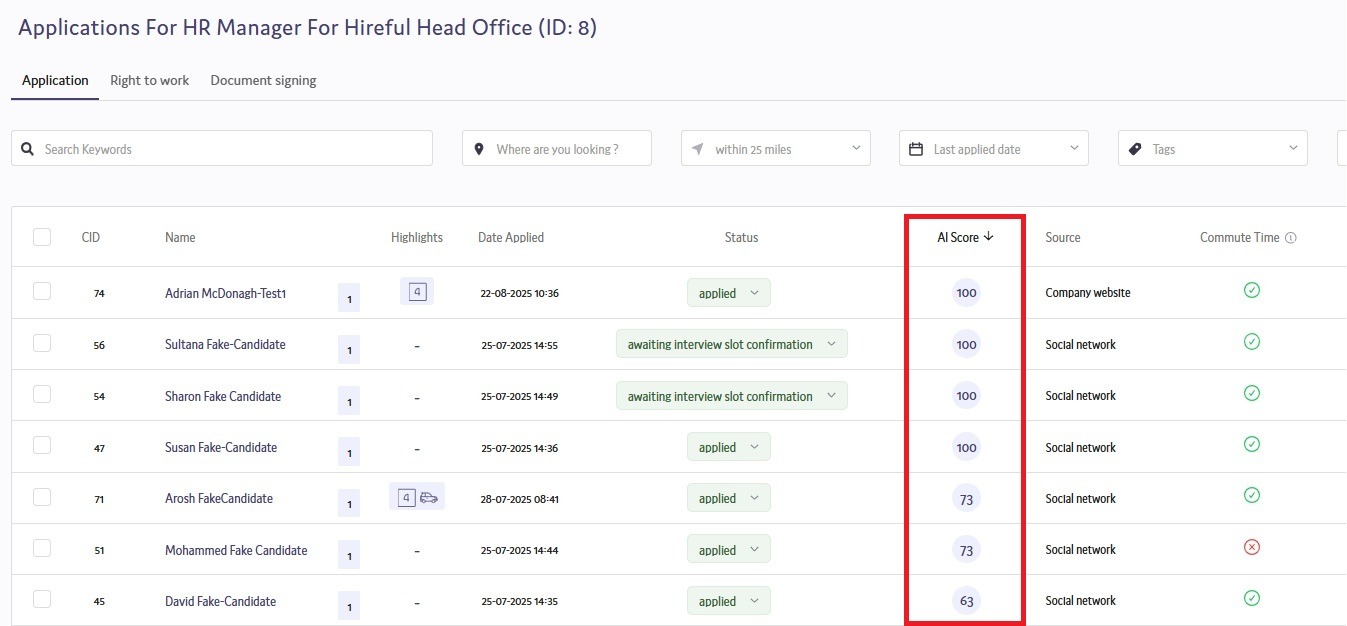
hireful's AI shortlisting feature was specifically designed to address this challenge. When you're receiving high volumes of Indeed Easy Apply candidates, having the ATS score applicants means you can identify your best candidates immediately rather than working through applications in date order. This lets you reach out to top talent before your competitors even finish reading their CVs.
The future factor
Tools like ChatGPT and Google's AI mode are changing how people search for jobs. When someone asks an AI assistant "What's it like to work at [company name]?", it pulls information from sources including Indeed reviews. Your Indeed presence is becoming part of your employer brand in ways that extend beyond job listings.
Pro tip: Check your company's Indeed rating and reviews regularly. AI-powered job search tools are increasingly referencing Indeed reviews (and Glassdoor) when candidates research employers, making your rating more important than ever.
How to evaluate an ATS for Indeed integration
When choosing an ATS for Indeed integration, you need to dig deeper than looking for the Indeed logo featuring on the ATS vendor’s website. Here are the specific capabilities to look for and the questions to ask vendors.
1. Check for job-by-job apply method control
The most important feature to look for is whether you can choose between Indeed Easy Apply and redirect-to-website on a role-by-role basis. This matters because different roles have different requirements. If you're hiring for a sales position where you just need volume and speed, Easy Apply makes sense. If you're recruiting for a role that requires a DBS check, detailed competency questions, or a thorough application form (common in charities and regulated sectors), you'll want candidates to complete your full application process.
With hireful, our customers can set this at the individual job level. A graduate scheme might use redirect-to-website with comprehensive application forms, whilst a hard-to-fill care worker role in the same organisation uses Easy Apply to maximise candidate volume. Not all ATS platforms offer this flexibility, so ask explicitly.
2. Verify source tracking and reporting
You need to know which candidates came from Indeed and, crucially, which application method they used. This data helps you make informed decisions about whether to use Easy Apply or redirect for similar roles in the future. Good source tracking also shows you the cost-effectiveness of any sponsored Indeed campaigns versus organic traffic.
hireful's reporting lets you see exactly how your Indeed strategy is performing, broken down by Easy Apply versus redirect, and compare those candidates' progression through your hiring stages. This visibility is essential for optimising your approach over time.
3. Ask about screening questions for Easy Apply
Indeed Easy Apply sends candidates with minimal friction, which means you might receive applications from jobseekers who did not spend a lot of time reviewing your job advert. For some roles, that's fine. For others, you need to qualify candidates before they hit your inbox. Check whether the ATS integration supports adding screening questions to Indeed Easy Apply applications. This lets you filter out unsuitable candidates automatically (for example, checking they have the right to work in the UK or hold a required qualification) without losing the benefits of Easy Apply's low friction.
4. Look for tools to handle high volumes quickly
If you're using Indeed Easy Apply, you're likely to receive more applications than redirect-to-website roles. That's the point, but it creates a processing challenge. Look for an ATS with features specifically designed to help you work through high volumes efficiently.
hireful's AI shortlisting scores every applicant against your criteria and sorts them by match quality. Instead of reading 200 CVs in chronological order, you can start with the candidates most likely to be a good fit and reach out to them immediately. The AI provides a summary of how each candidate matches (or doesn't match) your requirements, so you can make quick decisions without reading every CV in full. You can read more about how our AI shortlisting minimises bias here.
Pro tip: Before switching ATS, search Indeed for the roles you recruit most often in your location. If most of your competitors are using Easy Apply, you'll need an ATS that handles high application volumes efficiently, or you might struggle to keep up.
5. Confirm disposition data sync
Ask whether the ATS passes candidate status updates back to Indeed. When you move a candidate from "Applied" to "Reviewed & rejected" or "Interview scheduled," Indeed wants to know. This data helps Indeed improve their service, but more importantly for you, it qualifies you for Indeed's responsive employer badges. These badges appear on your job listings and signal to candidates that you actually respond to applications, making your roles more attractive in a competitive market.
6. Review the overall integration depth
Some ATS-Indeed integrations are basic (post jobs, receive applications) whilst others are more sophisticated.
Conclusion
Choosing an ATS with strong Indeed integration isn't just about posting jobs automatically. It's about having the control and tools to compete effectively for candidates in a market where Indeed dominates and speed matters more than ever. Look for job-by-job apply method control, robust source tracking, tools to handle high volumes quickly, and disposition data sync that earns you responsive employer badges.
The recruitment landscape is becoming increasingly two-speed: employers who engage candidates quickly are winning talent, whilst those using traditional processes find their best candidates have already accepted offers elsewhere. Your choice of ATS either supports that speed or becomes a bottleneck.
Ready to find out more about hireful's ATS and our Indeed integration?
When you are ready, feel free to contact our team to discuss how hireful's Indeed integration could streamline your recruitment process.
Frequently asked questions about ATS Indeed integration
How does ATS-Indeed integration actually work?
ATS-Indeed integration works by connecting your applicant tracking system directly to Indeed's platform through an API (application programming interface). When you publish a job in your ATS with Indeed enabled, the job details are automatically sent to Indeed and appear on their site. When candidates apply via Indeed Easy Apply, their information flows back into your ATS automatically, appearing as new applicants against the relevant vacancy. This two-way data flow eliminates manual job posting and candidate data entry. At hireful, we've built our Indeed integration to give you control over whether each role uses Easy Apply or redirects to your application form, whilst maintaining seamless data flow in both directions.
What's the difference between Indeed Easy Apply and standard redirect to ATS applications?
Indeed Apply (also called Easy Apply) lets candidates apply directly on Indeed using their stored CV and profile, typically in just a few clicks. Before easy apply all ATS applications required applicants to be redirected from Indeed to your careers site, where they complete your full application form. The practical difference is significant: Indeed Apply dramatically reduces friction and increases application volume (our data shows Indeed Easy Apply generates [XX]% more applications than redirect), but candidates submit less information upfront. Standard applications give you more detailed responses (competency questions, full employment history, DBS-ready information) but create more friction, leading to higher dropout rates. With hireful, you choose the right approach for each role: Easy Apply for hard-to-fill positions where volume matters, and redirect for roles requiring thorough screening. Over 40% of hireful customers are not for profits or charities and a good majority of these use redirect for roles requiring DBS checks, but they can also choose to use Easy Apply for harder to fill vacancies like fundraisers.
Do all ATS platforms integrate with Indeed the same way?
No, ATS platforms vary significantly in how they integrate with Indeed. Basic integrations simply post jobs and receive applications. More sophisticated integrations (like hireful's) offer job-by-job control over apply method, screening question sync for Easy Apply, disposition data feedback for responsive employer badges, and detailed source tracking in reporting.


.png)
%20(1).svg)
.png)