Inclusive job advert copy means writing adverts that give every candidate, regardless of background, disability, or identity, the genuine confidence to apply. It goes further than legal disclaimers and ED&I boilerplate statements, making specific, credible commitments about how your organisation actually works.
Most employers know they should be doing this. Few actually are. That gap between intent and execution? It's where qualified candidates quietly scroll past and never come back.
I've reviewed thousands of job adverts, and the pattern is consistent: organisations that think their adverts are inclusive are usually relying on a single disclaimer at the bottom to do work that the rest of the advert is actively undoing.
In this post, I'll walk through a practical checklist for writing truly inclusive job advert copy, covering language, structure, flexibility signposting, and the specific signals that candidates from underrepresented groups look for before they even consider hitting apply.
Contents
Why "equal opportunities employer" isn't working
The standard equal opportunities statement has become so ubiquitous in UK recruitment that it's effectively invisible. Candidates from minority groups aren't looking for a disclaimer. They're looking for evidence.
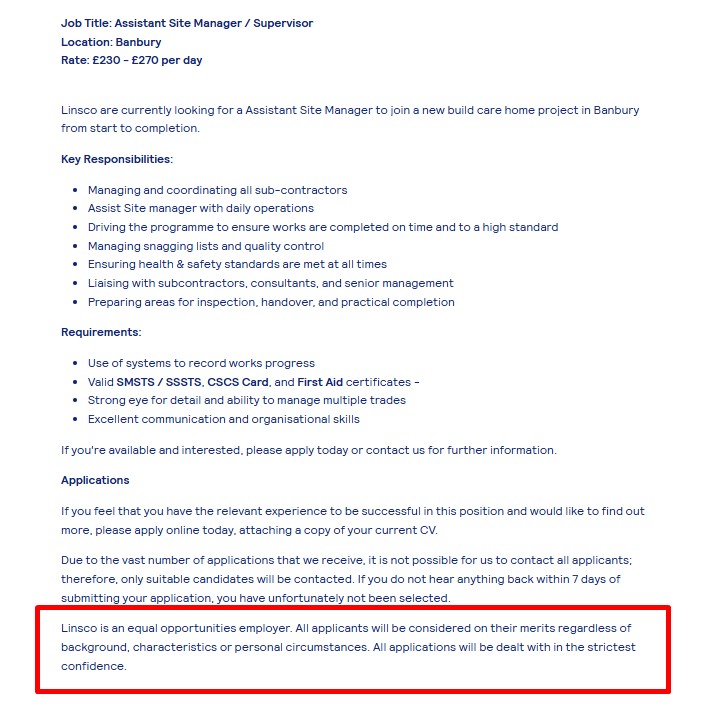
Think about what that statement actually communicates. It tells candidates you know discrimination is illegal. It doesn't tell them whether people like them currently work there, thrive there, or feel comfortable raising concerns. It signals that inclusion is something your legal team signed off, not something your organisation has genuinely wrestled with.
The checkbox approach has a compounding problem: it signals that no one has actually thought about this properly. When candidates see the same boilerplate disclaimer they've seen in every other advert from every other employer, the message they receive is that this organisation isn't confident enough in its inclusion practices to say anything specific. And if you're not confident enough to say something specific, why would a candidate take the risk of applying?
Below we have a screenshot from totaljobs.com (date: 06/03/2026) when you can see they have 51,996 jobs from direct employers (non-agency) and 16,571 of these jobs mention the term "equal opportunities employer". This is just under 1 in 3 jobs have this phrase.
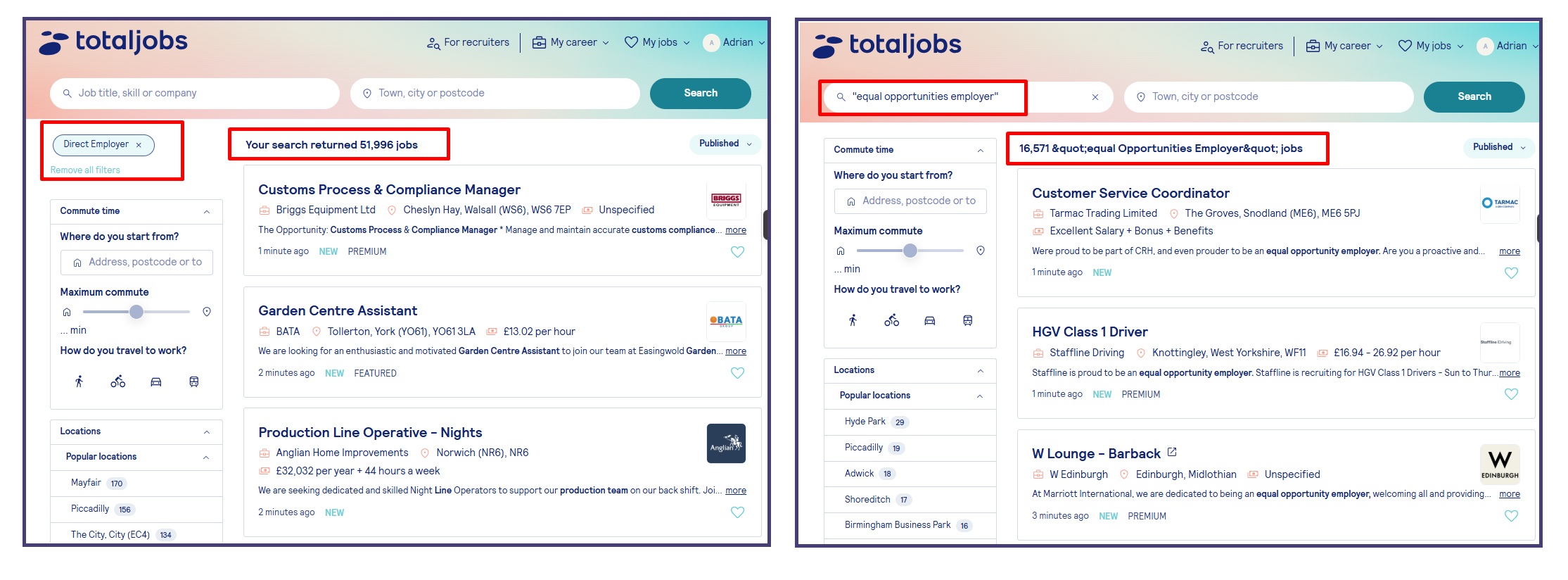
I would suggest that you are better off not mentioning ED&I if all you are going to do is add in a bland statement like this that so many other employers list.
How to show what you believe, not just what you're obliged to say
The best inclusive job advert copy treats ED&I as an emotive subject, and writes about it like one. It shares what the organisation actually feels, not just what the policy says.
This doesn't mean padding your advert with paragraphs of inclusion narrative. Your advert needs to be short and engaging, so the goal is to say something meaningful in a small number of words and then direct candidates somewhere they can learn more.
Here's what the difference looks like in practice:
Human and specific version: "We want this to be a place where everyone feels they belong. We run anonymous shortlisting, offer guaranteed interviews for disabled candidates who meet our minimum criteria, and will happily adjust our process if you need us to. If you want to know more about how we approach inclusion before you apply, reach out to [name] directly."
The second version is roughly the same length. It communicates the same legal coverage. But it makes a specific, verifiable commitment that candidates can actually use to assess whether they'd be welcome.
hireful supports anonymous application collection natively, which means organisations can implement this without any manual workaround.
How to explain your inclusive recruitment process in a job advert
If you've already taken steps to make your recruitment process fairer, don't bury that. It's one of the strongest signals you can give a jobseeker, so put it where people can actually see it.
The key is to go further than just listing what you do. Explain why you do it. That's the bit that turns a process description into a credible commitment.
For example, you might mention:
- That you use anonymous applications specifically to take unconscious bias out of shortlisting
- That you're a Disability Confident employer and offer a guaranteed interview scheme for disabled candidates who meet your minimum criteria
- That you actively encourage candidates to get in touch about what they need for a good experience (and say it warmly, not as a legal afterthought)

The technical mistakes that exclude candidates without you realising
Even well-intentioned inclusive job advert copy can undermine itself through specific technical choices. Here are the most common offenders.
How should job adverts refer to disability?
Outdated disability language appears in adverts far more often than recruiters realise. Phrases like "able-bodied," "suffers from," or describing a role as requiring someone to be "on their feet all day" without clarifying whether that's genuinely essential all create unnecessary friction for disabled candidates.
Use identity-first language where preferred ("disabled candidates") and don't frame disability as something to overcome or disclose as a barrier. Focus on what the role requires, not what it assumes about the candidate. The government have their own guide here on what words to use and avoid.

How to avoid listing requirements that aren't actually essential
The person specification is where a lot of adverts quietly exclude large groups of candidates. Research from the UK's Behavioural Insights Team found that men say they'd apply when they meet about 52% of listed requirements, while women typically hold off until they meet around 56%.
That gap might sound small, but it compounds across every role you advertise. Other studies back this up: women are more likely to feel they need to meet all the stated criteria before they'll hit apply.
So if your person spec is long and rigid, you're filtering out qualified women before they even get to the application form, and that feeds directly into the gender gaps in seniority and pay that most organisations say they want to fix.
Before you publish, go through every requirement and ask yourself: is this genuinely essential for day one, or is it something we'd prefer but could develop? If it's the latter, move it to a "desirable" column or remove it entirely.
How does gendered language in job adverts affect who applies?
Certain words consistently attract more applications from men and put off women, based on repeated academic analysis of job advert language. You get both female-coded and male-coded terms, but statistically it's only the male-coded ones that actively discourage women from applying. Those are the ones to watch for.
That said, context matters. Not every use of a word like "competitive" is a problem. "Competitive salary" puts off male and female applicants at roughly the same rate, because it's describing the pay, not the culture. But "competitive environment" or "competitive culture" is a different story: that kind of language is far more likely to discourage female applicants, because it's describing what it feels like to work there.
Male-gendered words to potentially avoid/replace (depending on the context):
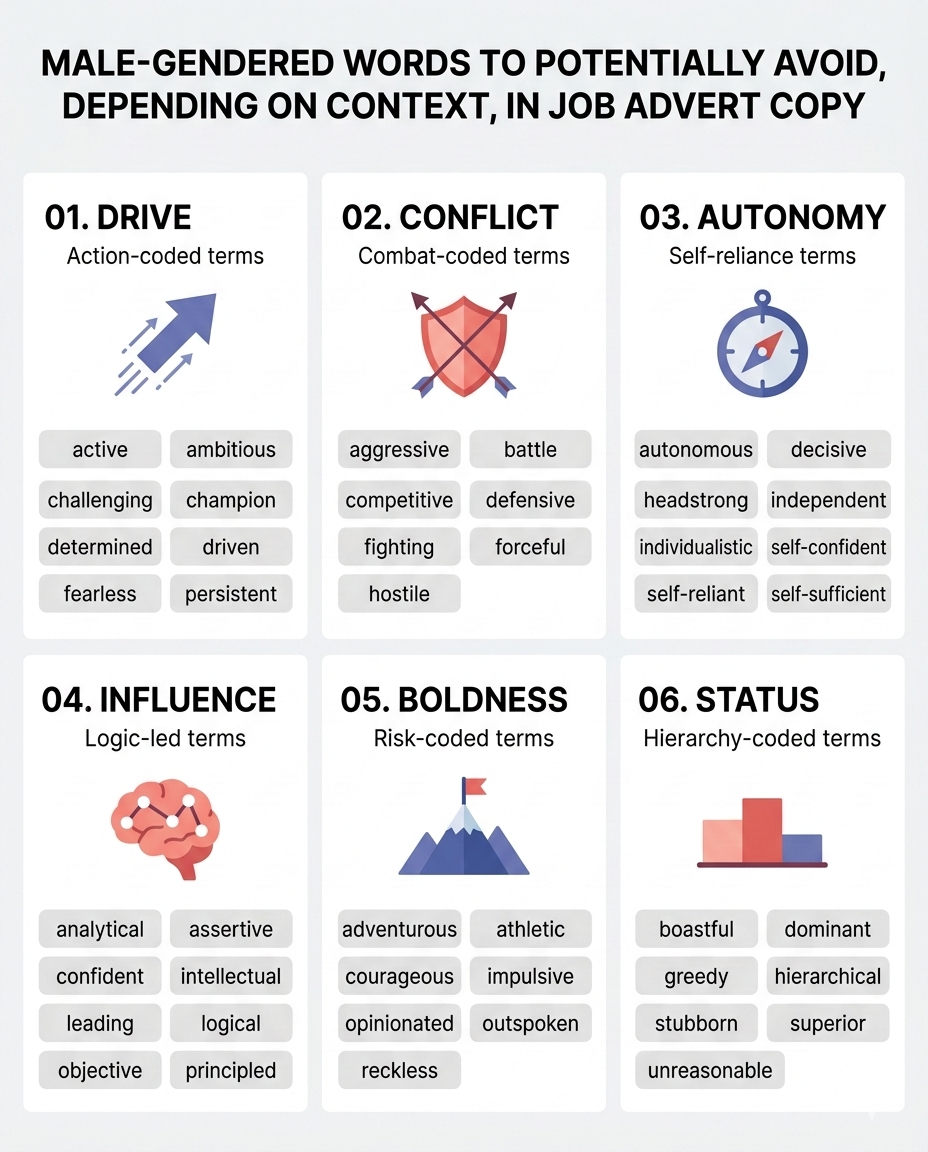
This isn't about softening the role. It's about describing it accurately in language that doesn't inadvertently code it as "for men."
Why readability matters for inclusive job adverts
If your advert uses industry jargon, unexplained acronyms, or long dense paragraphs, you've already lost candidates before they've worked out whether they're qualified. Aim for a reading age of around 12-14 years (which is roughly the standard for accessible public communications). Short sentences. Active verbs. Plain language.
Why flexibility signposting is a pipeline decision, not a perk
If your job advert doesn't mention flexible, hybrid, or part-time options, most candidates will assume the answer is no. They won't ask. They'll just move on.
This matters because the people most likely to need flexibility are the people most likely to be underrepresented in your workforce:
- Carers (predominantly women) need flexibility
- Disabled candidates often need it
- People returning from career breaks need it
- Parents with school-aged children need it
If your advert is silent on flexibility, you are disproportionately filtering out these groups before they ever reach the application stage.
The fix is straightforward. You don't have to offer everything. But you do have to say something. Even if the role has constraints around location or hours, stating those constraints clearly and honestly is better than silence. "This role is based on-site three days a week, with flexibility on the remaining two" is far more attractive to a diverse candidate pool than a location listed with no further context.
The numbers argument is compelling: every candidate who assumes "no" and doesn't apply is a qualified person you never get to assess. Broadening your flexibility offer, or simply being explicit about what you do offer, directly broadens your talent pool.
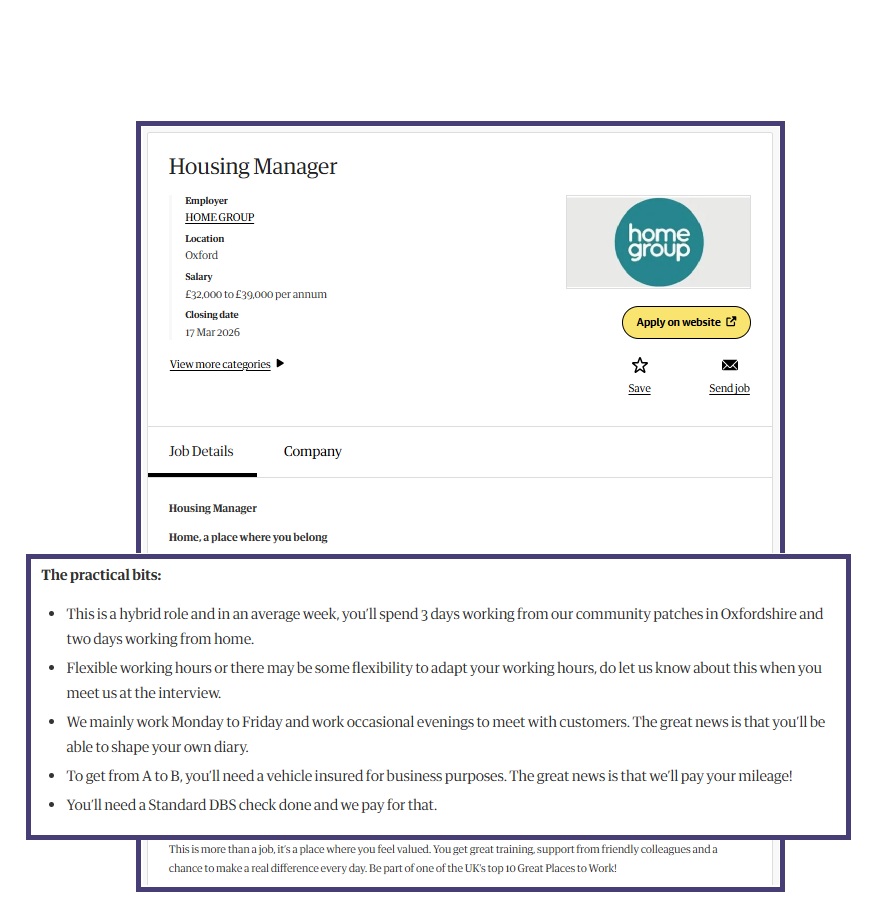
Pro tip: If you're genuinely open to discussing flexible arrangements on a case-by-case basis, say so explicitly. "We're open to discussing flexible arrangements for the right candidate" costs nothing and captures candidates who would otherwise self-select out. Check out the best practice example below from Home Group.
How to write job adverts that work for neurodiverse candidates {#neurodiverse-candidates}
Vague soft skill requirements are one of the most common barriers to neurodiverse candidates in inclusive job advert copy, and one of the easiest to fix.
Phrases like "excellent communication skills," "able to work independently," or "good team player" are meaningless without context. For neurotypical candidates, these phrases are so familiar they barely register. For many neurodiverse candidates, particularly those with autism or ADHD, vague language creates genuine uncertainty about whether they'd meet the expectation, even when they clearly would.
Plain English isn't dumbing down. It's precision. Rewriting vague phrases in specific, role-relevant terms makes your advert better for everyone while being genuinely accessible for neurodiverse candidates.
Here's an example:
- Vague version: "Excellent rapport building skills required."
- Specific version: "You'll greet customers and provide them a tour of our facilities. Taking the time to talk with them, understand what they are looking for and build a trusting relationship with them."
Same expectation. Totally different level of clarity. The specific version also helps all candidates self-assess accurately, which means you get more relevant applications and fewer people applying for roles that aren't a fit.
Pro tip: Consider including a brief "what working here looks like day-to-day" section in your advert or on the linked job page. Even two or three bullet points about typical days, meeting cadences, and communication norms can seriously cut down the uncertainty that causes neurodiverse candidates to rule themselves out.

The bottom line on inclusive job advert copy
Inclusive job adverts are not about saying the right things. They're about doing the work so the right people actually believe you. If your organisation has done the work to make itself more inclusive then you will be able to stand out from the rest of the competition who ignore this area or those that just cut and paste "we are an equal opportunities employer".
Frequently asked questions about inclusive job advert copy
What is inclusive job advert copy?
Inclusive job advert copy is recruitment advertising written to give all candidates, regardless of background, disability, gender, or identity, the genuine confidence to apply. It goes beyond standard equal opportunities disclaimers to use specific, accessible language, flag meaningful inclusion commitments, and avoid technical barriers like gendered language, vague requirements, and poor readability. The goal is not to meet a legal minimum but to actively signal to underrepresented candidates that they would be welcome.
Does inclusive job advert copy mean lowering hiring standards?
No. Inclusive job advert copy is about describing your actual requirements clearly, not reducing them. It means removing language that inadvertently codes roles as suitable for one type of person, cutting requirements that aren't genuinely essential, and being specific rather than vague about what the job actually involves. In practice, this tends to improve the quality and diversity of your applicant pool at the same time, because more of the right people apply.
How do I know if my job advert language is excluding candidates?
Common warning signs include:
- Long lists of essential requirements
- Gendered language like "aggressive targets" or "strong man-management"
- Vague soft skill requests like "excellent communicator" without context
- No mention of flexible working
- A boilerplate ED&I statement as the only inclusion signal
Should I mention salary in a job advert for inclusion reasons?
Yes, wherever possible. Pay transparency disproportionately benefits candidates who are less likely to negotiate (including women and candidates from lower socioeconomic backgrounds) and removes a real barrier to applying. Candidates who don't apply because there's no salary range listed are candidates you never get to assess. Publishing a range, even a broad one, removes that friction.
How long should the inclusion section of a job advert be?
Keep it short: two to four sentences in the body of the advert, with a link or a reference (it is not always possible to add a link to a job board advert for example) to a more detailed page on your careers site or website where candidates can learn more.
The advert is not the place for a full ED&I statement. It's the place to make one specific, credible signal that you've thought about this properly, and point candidates somewhere they can check for themselves.
Editor's note: This post was originally published in March 2026 and has been updated for comprehensiveness.



.png)
%20(1).svg)
.png)